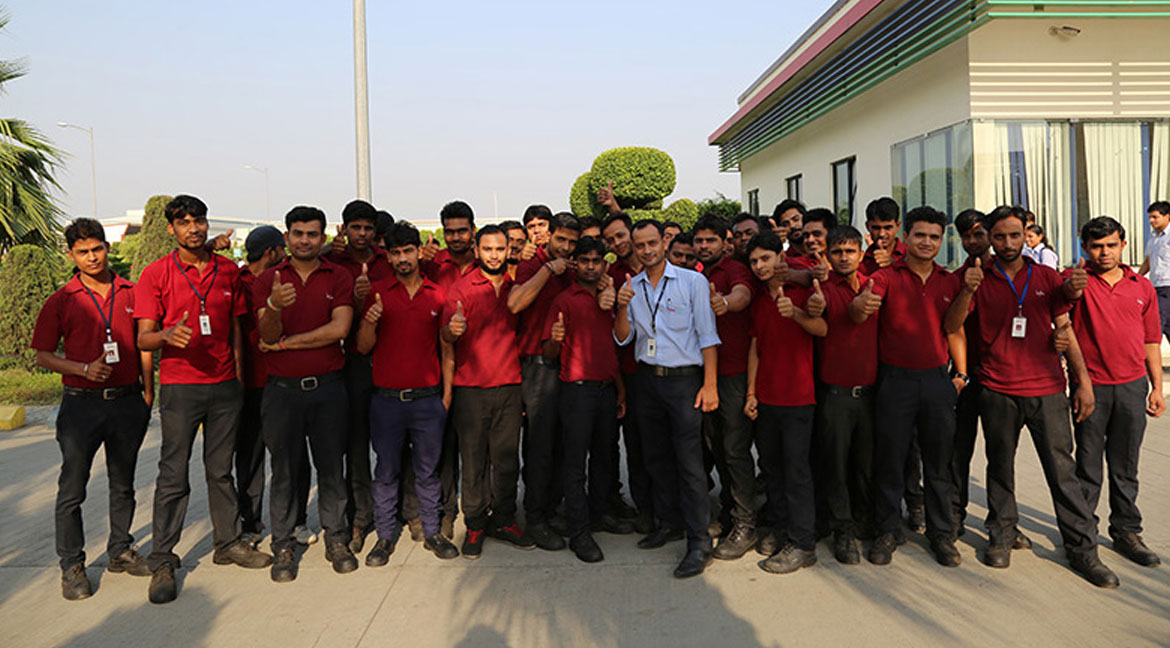


EX EMPLOYEES ARE OUR BIGGEST CHEERLEADERS!

Layam Group is not a company in the true sense, it’s an institution which strongly believes in intellectual growth. In fact, you can call Layam a ‘Gurukul’. We have created a strategy for Cost, Quality and productivity with an emphasis on People, Process and Performance. We have emerged as the Catalyst for Growth for many companies and our employees alike. Our pioneering concept of head count to brain count has benefited over 15,000 people who have moved ahead on their career path thanks to our upskilling process of making them ‘industry ready’.  Likewise, our employees too view Layam as the perfect training ground to hone their skills. From a trainee executive to HODs, we make sure that learning process does not cease. Most of our employees who have moved on to other companies have left on a positive note. Employees may have chosen to move on for various reasons like family or health issues or a better opportunity, but each one of them have left Layam with a positive outlook. Our ex-employees have openly expressed that they feel enriched by the knowledge and confidence they have gained by working in Layam. Needless to say, all ex Layamites continue to stay in touch with us and yearn to come back to Layam one day.

We can proudly say that HR as a partner in progress is a concept that we have successfully implemented amongst our stakeholders and our ex-employees too!  Today, our ex-employees have emerged as the true brand ambassador of Layam as they play an important role in our recruiting and branding strategy. As the importance of relationships and networking gains momentum, Layam has successfully showcased that creating and nurturing the network of ex-employees is a step in the right direction.


Share this:

BEHAVIOR IN INCREMENT TIMES

During my professional tenure, I have always enjoyed the increment period by observing the amusing behaviour pattern of employees. Suddenly, everything changes. It’s rather nice to see that all are falling within the norms of the organization. I used to always wonder, ‘Is money such an influential factor that it controls the emotions, attitude as well as behaviour of an individual’?. I don’t know, may be yes but why? Why can’t we be consistent, again this is a debatable point 

Increment is that time of the year when I notice ‘change’ or a transformation in few of my colleagues. In terms of discipline, attention to detail, meeting deadlines, obeying superiors, basically, every aspect that goes into making a conducive and productive work environment is adhered to by this sect of people preceding increment time. A senior executive in my office noticed this change and asked me, “Sir, did someone wave a magic wand on them?”. Of course not, it’s increment spellyou silly, was my retort. This attitudinal drift that afflicts some people is a common trend that has withstood the sands of time! remember noticing a similar behaviour pattern in my previous workplaces too way back in the 80s and 90s.  

My friends who work in various industries and corporate set up across the globe often speak about this infuriating trendThe fact of the matter is when increment time is around the corner, employee’s behaviour changes for the better…. in every aspect. They agree to take on as much work load as possible without a whimper and may also go to the extent of taking on some tasks of their immediate superiors too! Such camaraderie and team spirit can leave your HR team speechless or rather job less. How I wish such positive actions continues at all times. But here, I must admit that there are several individuals in my office who work in a steadfast manner throughout the year irrespective of the “I”(read increment) time. Such people are the ones, I believe, who work with a sense of ownership. They consider ‘Layam’ as their own company and put their heart and soul in giving their best. So, their mindset is that of an owner rather than an employee. Their motto is simple- This is our company and we need to work hard to achieve more”– their effort and enthusiasm personifies this statement. 

Empowering people by inculcating a sense of ownership towards their career as well as the job would help them to achieve the desired results, whether increment or otherwise. Layam is fortunate to achieve this.   

Share this:

Behavioural Skills – A stepping Stone for Success

You have already written a blog on soft skills, so why are you writing on the same topic again”? asked my nephew in a puzzled tone when I keyed in the title of this blog. “Look closely, the title says behavioural skills and not soft skills,”, I clarified. Soft skills or behavioural skills? Aren’t they one and the same, so why bother to call it by different names?”, he retorted. Soon, I realized that this misperception was shared by many of my friends and colleagues. I don’t claim to be an authority on either of the two subjects but I know for sure that people should know the difference between them. This blog is an attempt to do so and also understand the importance of behavioural skills.  

Soft skills as mentioned in my previous blog is the “abilities required in the workplace for professional success” (Georges, 1996). The abilities are essentially skills like good communication, networking abilities, compassion etc. These habits or skills have become a pre requisite in the dynamic environment that we work in todayHaving said that, it doesn’t mean that I am undermining the importance of behavioural skills. Well, that brings us back to the question of what exactly is behavioural skills? The most popular definition goes like this – Behavioural skills are the skills you use to successfully interact with others in the workplace. They are competencies employees need to be successful in a job and/or in an organization.  

behavioural skills specialist has claimed that employees need to have specific skills that enable them to face the demands of modern working life. It’s these skills which will ultimately turn an average performer into an excellent performer. Liggy Webb, founding director of The Learning Architect, a consortium for behavioural skills specialists, has identified 20 key skills that workers must have to be effective. It forms part of a wider portfolio designed to support the 21st century workforce. Based on research using the UNESCO (United Nations Educational, Scientific and Cultural Organisation) model and her work with The Learning Architect, the skills list outlines work that employers need to address in order to create a happy and successful firm. This includes: 

  • Change ability
  • Communication
  • Conflict resolution
  • Creativity 
  • Decision making
  • Empathy
  • Feedback
  • Goal setting
  • Healthy living
  • Life balance
  • Impact and influencing
  • Positive thinking
  • Problem solving
  • Relationship building
  • Relaxation 
  • Self-confidence
  • Stress management
  • Time management
  • Value and purpose

Just like soft skills, behaviour skills can be taught through a structured training programme. Dr. Miltenberger defines Behaviour Skills Training as “a procedure consisting of instruction, modellingbehavioural rehearsal, and feedback that is used to teach new behaviours or skills”. It’s a simple teaching program that can be modified as per the individual’s requirement or circumstances.  According to the aforementioned definition, the 4 step module include: 

Instruction – To imbibe a particular skill, it’s necessary to understand the meaning. Explain the skill in such a way that the trainee understands it’s significance and validation. It’s important that the trainer elucidate the circumstances under which he/she can use this skill and also clarify when not to use it.  

Modelling – Practical knowledge at times is more comprehensible than theory. This step will involve the trainer enacting or performing the skill.  

Rehearsal – Practice makes a man perfect. This old adage holds good in acquiring a behavioural skill. By practising a particular skill, the trainer will be able to identify correct/incorrect response.  

Feedback –  It’s necessary that that the trainer gives remedial feedback for incorrect response and likewise should not hesitate in showering praises for correct response.   

Real situations in professional and personal life can not only sharpen your behavioural skills but will ensure lifelong success. It’s never too late to learn a skill but do not get into the habit of procrastination! 

Share this:

7 ESSENTIAL TIPS TO MAKE YOUR WORK EXCITING AND ENRICHING

Often, I have been asked about the secret behind my success. Let me assure there is no hidden secret about the moderate accomplishments I may have achieved in the last 37 years of my professional career. However, I can certainly tell you that I have adhered to the following tips since the beginning of my professional journey and it has definitely held me in good stead.  I call it the essential tips that can make your job exciting and enriching. Needless to say, productivity will soon ensue 

  1. Doing things strategically– I always look beyond the immediate and into the future…maybe 3 or 5 years down the lane. Where do I see myself? This is an oft repeated question in my mind which I have been asking myself since the beginning of my career. This helps to prioritize my goals, plan ahead, delegate effectively and work towards implementation. Another question I asked myself when I started Layam Group in 2007 was “will our business create any difference in the lives of people?”, Today I have a definitive answer to this-‘Layam has certainly helped achieve the dreams of others- the culture of doing things strategically is an omnipresent trait of every employee and it has certainly created a differentiator in terms of the 10,000 people whom we have made employable or the number of clients who have been impacted by our tenets of cost, quality and productivity.
  2. Ideating with others-When I discuss my plans, ideas or strategies with my team, it’s with an intention to seek the other person’s perspective. Working alone or in isolation will not help me get the idea into momentum or for that matter increase my productivity or that of my team. 
  3. Empowering– One tip is to learn the fine art of delegating. Delegate your work to your juniors or team members. This is one way of empowering them. It also helps them to develop their talents or skills and become more productive  
  4. Taking lessons from success and mistakes– For me learning is a continuous process. For that matter, every moment, I try to find opportunities to learn or improve myself.  We learn from our mistakes-we have all heard about this insight and realized the true meaning behind it. But if something goes well, I delve deep and scrutinize-What were the factors that helped us in finishing this project so successfully? Can we incorporate few elements into future projects as well? The scope of improvement is the mantra 
  5. Energy Management– Time Management, work life balance, Productivity and quality of work can all be achieved if you are left with sufficient mental and physical energy. If you are tired and unable to put on your thinking cap, then you may end up doing fewer tasks for a longer duration of time.  Managing your energy levels is important to increase workplace productivity. This can be easily achieved by following a healthy lifestyle, which essentially implies eating timely and healthy meals, exercising regularly and going for short spiritual journey in terms of practicing meditation, reiki or the likes. 
  6. Cut the clutter to usher in clarity-Here, I am essentially referring to the physical clutter. Your workplace should always be well organized and clutter free. A clean workplace will give you a sense of clarity and help you to focus better. 
  7. Take buffer time to recharge– Non-stop meetings and deadlines may leave you with little or no time to think. Take ‘quality’ breaks. This will help you recharge your brain not to mention your energy levels. I seldom pack my day with client meetings or team meetings. I take some time off to deal with phone calls, messages, mails or simply do nothing at all. A 20-30 minutes break between a hectic work schedule can break the monotony and help you bounce back with renewed vigor.  

Bill Cosby had once said, “In order to succeed your desire for success should be greater than your fear for failure”. I follow this maxim to the fullest and my advice to you is to have the passion and desire to reach for the stars. You may soon realize that even in the toughest situations, you don’t tend to give up because your passion to succeed will emerge stronger eventually defeating your fear of failure!  

Share this:
×

Please Fill the Details below will share the required document to your email.